Personalized Orders
Post-purchase journey redesign focused on upsell, personalization and friction reduction.
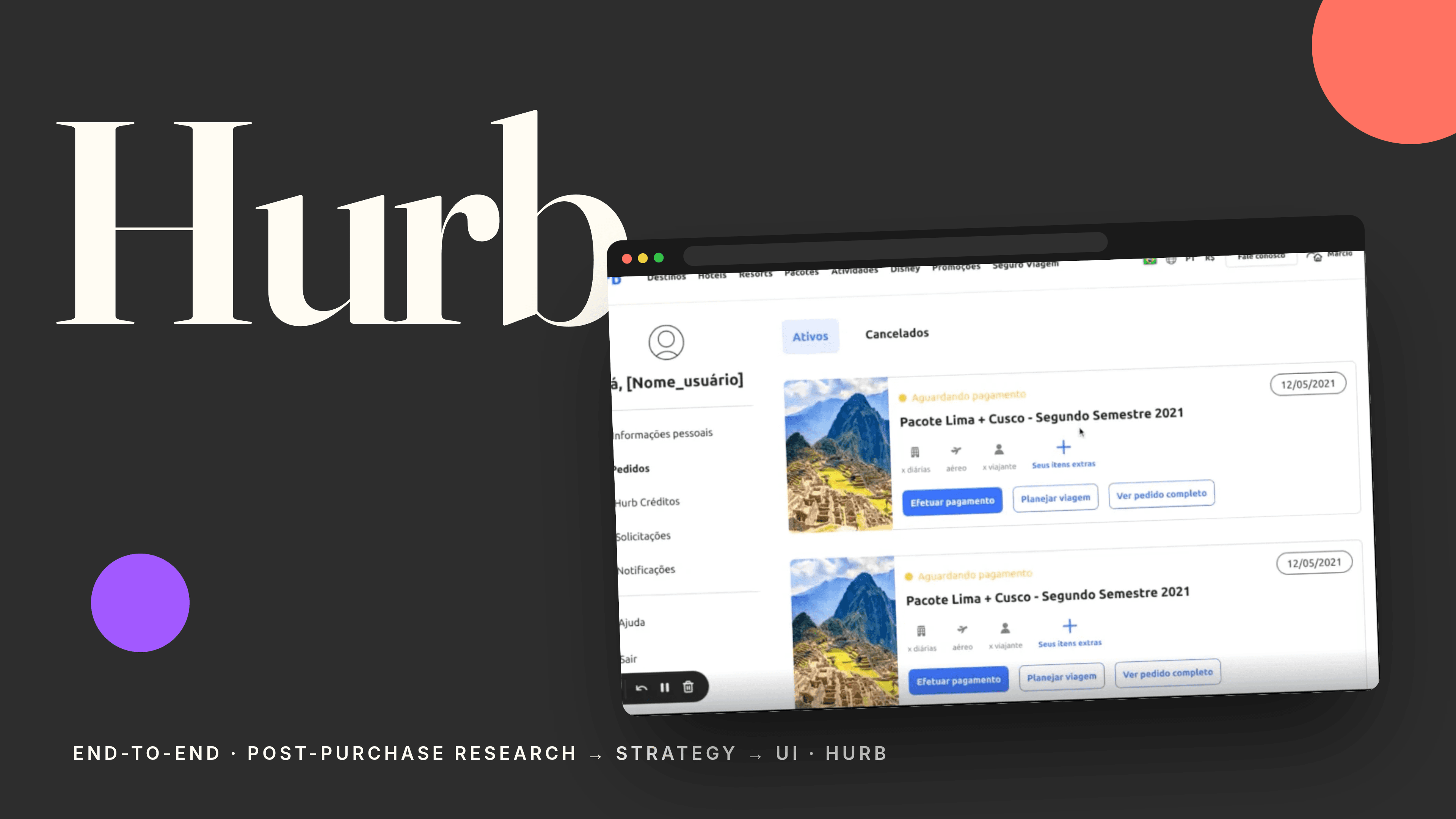
Design as a direct revenue lever in the Revenue Optimization Squad
At Hurb, I joined the Revenue Optimization Squad with a clear business objective: increase post-purchase journey revenue via upsell and cross-sell. The platform had multiple additional products available — transfer, insurance, tours, hotel upgrade — but users simply could not find them or did not understand the value.
The challenge was twofold: discovering what travelers truly needed (not just what the company wanted to sell) and designing an experience that felt like personalization, not push selling.
Three hypotheses before any research
Customers could not find additional products because they were not in the natural usage flow — accessible, but not discoverable.
Users were not impacted in a standardized way in the post-purchase journey — each touchpoint was disconnected from the previous one.
The user felt they bought a closed package, not that they were building their own trip. Personalization was technically possible, but not communicated.
7 in-depth interviews to map the real journey
Before any solution, we needed to listen to travelers. I conducted 7 in-depth interviews between March 6 and 13, 2023, focused on the complete post-purchase journey — from order confirmation to check-in.
Most reported difficulty contacting Hurb by email and not seeing date change communications in time. "The biggest problem is the process until receiving the ticket." Output: opportunity for WhatsApp reminders and a proactive email communication journey.
Travelers mentioned they did not know additional products were available — transfer, car rental, insurance. "I didn't know there were additional products on Hurb." Output: need to differentiate extras from personalization — they are distinct needs requiring separate entry points.
Most travelers said the hotels fell short of expectations and they would pay more for a better option. "I didn't like some hotels, below standard. I would pay to upgrade." Output: hotel upsell opportunity as the main revenue and satisfaction lever.
Travelers planned months in advance and wanted all trip information in one place. "I always make an itinerary of places I want to visit months before." Output: opportunity for a personalized trip planner integrated with the order.
Journey workshop with 8 to 10 people
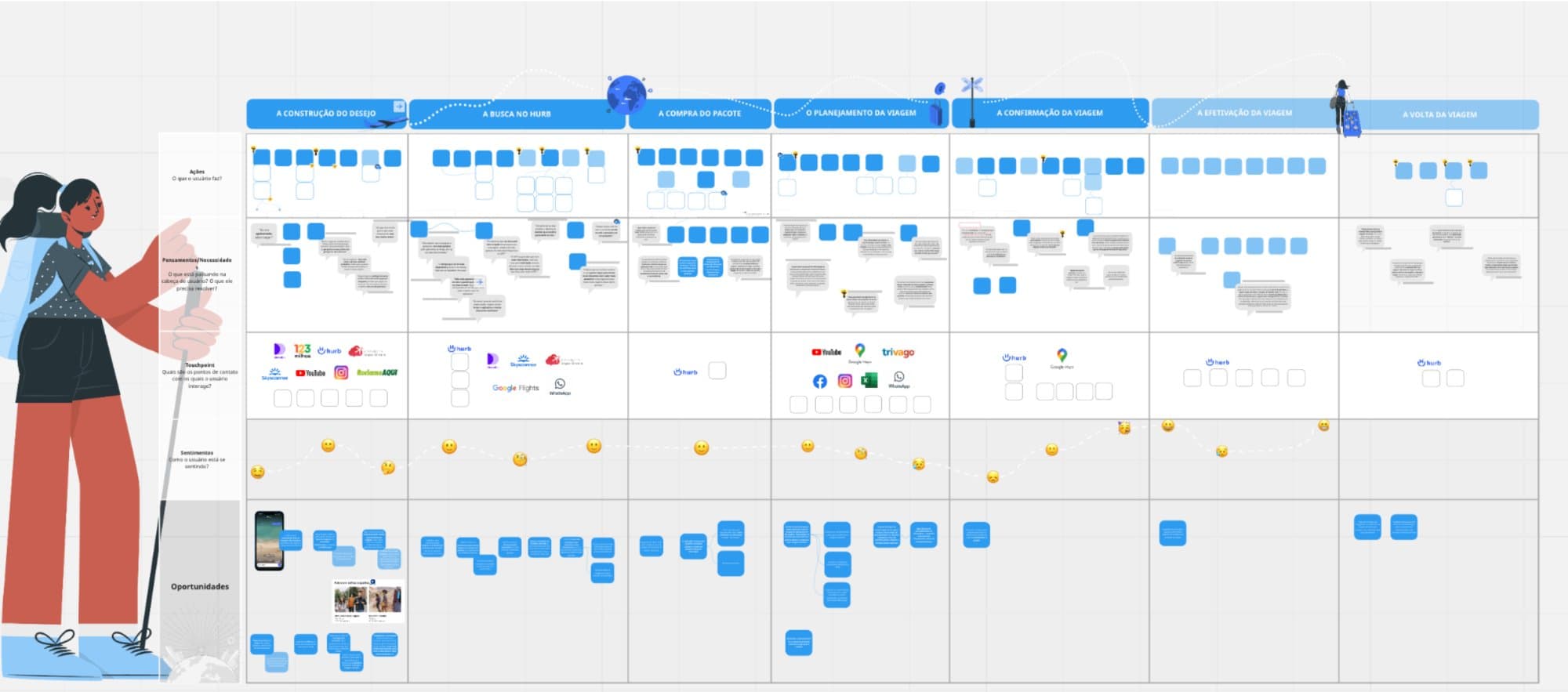
With qualitative findings in hand, I facilitated a post-purchase journey mapping workshop with 8 to 10 participants — PDs, Researcher, Content, PM and Devs. The goal was to convert insights into prioritized opportunities.
Key opportunities mapped: new cross/upsell options focused on hotel, customizable trip planner, order personalization in account onboarding, travel tips and content, document checklist and pre-trip support.
Survey with 1,109 respondents to prioritize by data
To prioritize opportunities with concrete data, I ran a quantitative survey via Hotjar directly on the Orders page between April 20 and 24, 2023 — with 1,109 respondents.
Results were revealing: 38.6% wanted to choose a better hotel — the highest single demand. Next: add extra luggage (26.2%), upgrade the flight (22.9%) and choose a better room (12.4%). With 63% of the base having bought domestic packages, hotel upsell consolidated as the main opportunity.
New personalized orders flow: 3 delivery layers
The solution was designed to create an experience where the traveler felt they were building their own trip — not buying a closed package. Three layers of progressive delivery:
First MVP: contextual modal with additional products relevant to the destination and traveler profile. Presented as complements, not interruptions. Positive result in first months: revenue increase and growth in orders with additional items contracted.
Redesigned to give visibility to available extra items and trip status, with a direct shortcut to the personalization page — eliminating the "invisibility" problem identified in interviews.
Complete extras hub with category filter, replacing the previous generic listing. Integrated with a trip planner and document checklist to create a centralized planning experience.
Impact and honesty about what was implemented
The extras modal (V0) achieved positive results in the first months with revenue growth. The complete project — travel planner and hotel upsell — was not fully implemented due to the staff cuts the company went through in mid-2023, which drastically reduced the team and active customer base.
Time at Hurb was an intense immersion in revenue-driven design under high pressure — where the ability to prioritize, validate fast and deliver MVP before the full scope makes all the difference.
Measured impact
What I would do differently
I would prioritize delivering the MVP faster. In a startup context with limited resources and uncertainty, validating the main loop before building the full scope is the right decision. V0 (modal) was launched and had positive impact — the rest stayed on paper. I learned to negotiate scope aggressively and defend MVPs with data.
I would monitor business health more closely. Signs of financial pressure existed before the cuts — earlier conversations with leadership could have led to different prioritization. A senior designer does not work only on the interface: they need to understand the business context to make good prioritization decisions.